CARACAS, VENEZUELA — In a significant development for Venezuela’s political future, opposition leader and 2025 Nobel Peace Prize laureate María Corina Machado has returned to her homeland after spending nearly ten months outside the country.
Her arrival on Sunday, October 25, 2026, marks a new chapter in Venezuela’s ongoing political transition, coming months after the removal of former President Nicolás Maduro by United States military forces in January.
Machado announced her return through social media, writing a brief but powerful message: “I am here. With you.”
Her homecoming was met with celebrations as supporters gathered to welcome the opposition figure, whose political movement has spent years calling for democratic elections and institutional reform.
A Homecoming That Captured National Attention
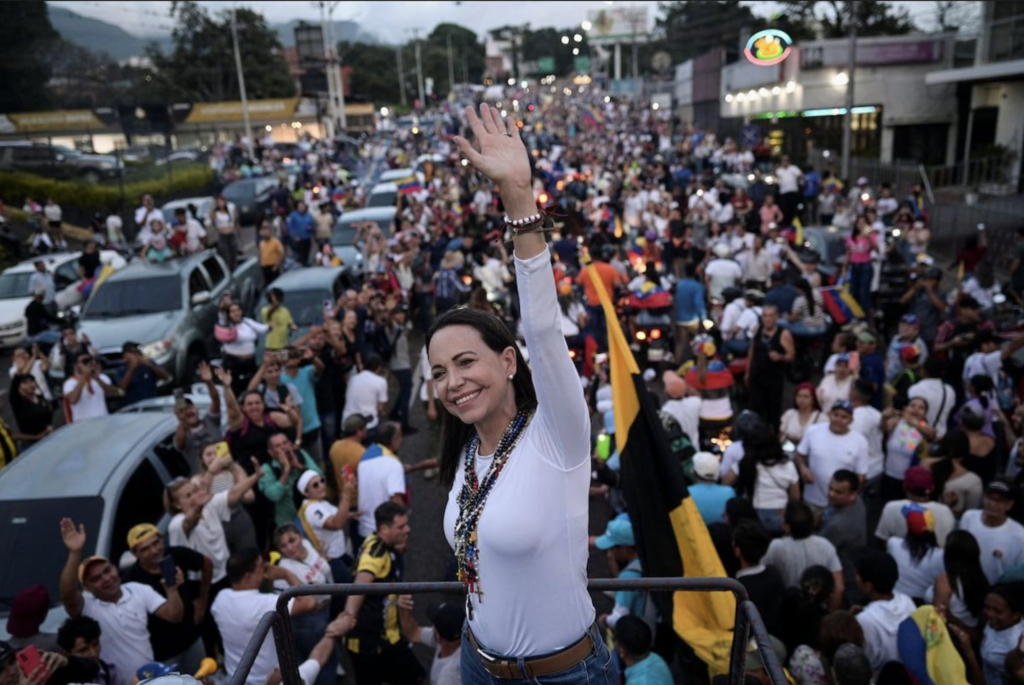
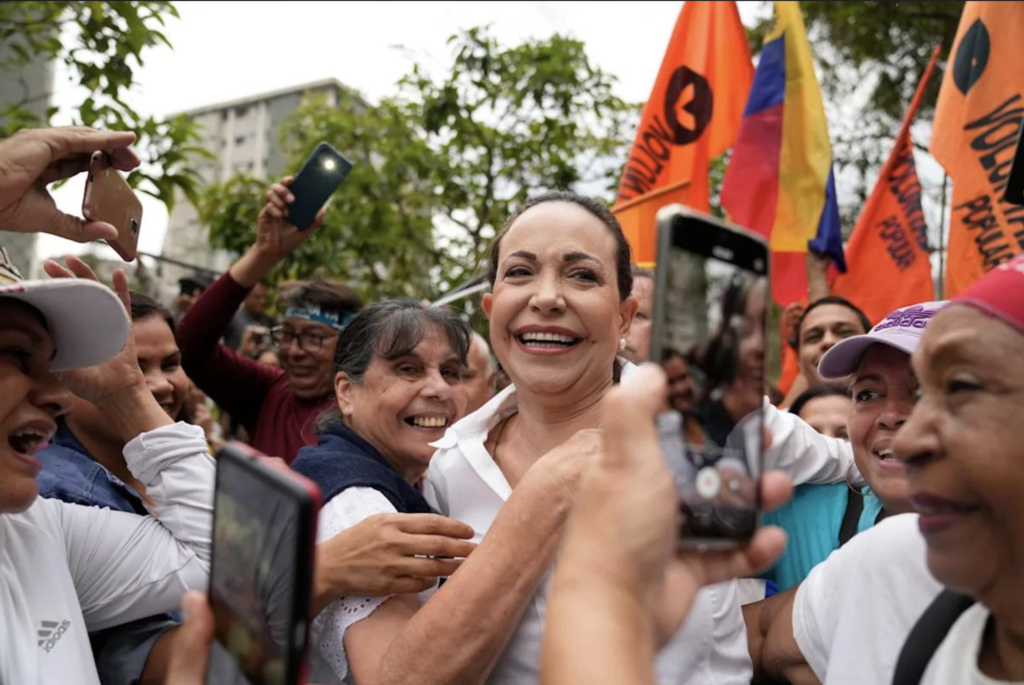
Machado’s return brought emotional scenes to parts of Venezuela, including Lara state, where she appeared at the Church of Santa Rosa near Barquisimeto.
Supporters applauded, embraced her, and gathered with Venezuelan flags as news of her arrival spread.
Crowds subsequently welcomed her along the route toward Caracas, reflecting the strong public support she continues to command within Venezuela’s opposition movement.
For many of her supporters, Machado’s reappearance represents an opportunity to renew demands for political participation and democratic elections.
However, her return also creates new questions about the relationship between Venezuela’s opposition, its interim government, and Washington.
Who Is María Corina Machado?
Born in Caracas on October 7, 1967, María Corina Machado is a Venezuelan politician, former National Assembly member, and longtime opposition activist.
A trained industrial engineer, Machado became widely known for her involvement in efforts to promote electoral transparency and democratic participation.
She co-founded Súmate, a Venezuelan civil society organization focused on electoral processes and citizen participation.
Over the following two decades, she emerged as one of the country’s most recognizable opposition figures.
In 2023, Machado won the opposition’s presidential primary but was barred by Venezuelan authorities from competing in the 2024 presidential election.
Edmundo González Urrutia subsequently became the principal opposition presidential candidate.
The 2024 election became the center of international controversy after Maduro’s government declared victory without publishing complete, independently verifiable polling-station results. The opposition presented detailed voting records that it said demonstrated González’s victory.
Machado’s years of political activism led to her receiving the 2025 Nobel Peace Prize, bringing further international attention to Venezuela’s democratic struggle.
Venezuela After Nicolás Maduro
Machado returns to a significantly altered political environment.
In January 2026, American military forces captured Nicolás Maduro, ending his presidency and bringing about a major shift in Venezuela’s leadership.
Delcy Rodríguez, who served as vice president under Maduro, subsequently assumed the role of interim president with support from the Trump administration.
The transition has not produced an immediate presidential election.
Instead, the interim administration and Washington have emphasized institutional negotiations, economic stabilization, and efforts to rebuild Venezuela’s economy.
Machado and her political allies, meanwhile, have continued to press for a clearly defined electoral timetable.
Her return places those competing priorities back into the international spotlight.
The United States and Venezuela’s Political Transition
The relationship between Washington and Venezuela remains a central component of the country’s political future.
The Trump administration has supported cooperation with interim President Rodríguez, particularly on economic matters and the reopening of opportunities for American businesses.
Venezuela possesses some of the world’s largest proven oil reserves, making its political stability important to international energy markets.
Machado has argued that lasting economic stability requires democratic institutions and a government with electoral legitimacy.
Her position introduces a different emphasis from Washington’s current approach, which has prioritized economic recovery and institutional negotiations before holding elections.
These differing priorities could shape the next phase of Venezuela’s transition.
What Happens Next?
Despite Machado’s return, several major questions remain unanswered.
Venezuela has not announced a confirmed date for its next presidential election.
The future of negotiations between the interim administration and opposition representatives remains uncertain, particularly because Machado’s political movement has not been directly involved in some of the ongoing discussions.
Edmundo González Urrutia, who has been living in exile in Spain, has also indicated that he intends to return to Venezuela.
International observers will be watching how the interim government responds to Machado’s presence, whether the political negotiations expand, and whether a timetable for national elections emerges.
A Defining Moment for Venezuela
María Corina Machado’s return is more than a personal homecoming. It brings a prominent opposition leader back into a country navigating one of the most consequential political transitions in its recent history.
Her arrival has energized supporters while underscoring the uncertainty surrounding Venezuela’s next government, its relationship with the United States, and the prospect of future elections.
For Venezuela and its millions of citizens living both at home and abroad, the central question remains whether the current transition will ultimately produce a stable political system with competitive elections and lasting democratic institutions.