
Colette Kress has been named interim CEO as NVIDIA begins the first CEO search in the company’s history.
One of the most consequential leadership runs in modern technology has come to an abrupt end.
Jensen Huang has resigned as president and chief executive officer of NVIDIA, the company he co-founded in 1993 and transformed from a graphics-chip startup into the dominant force behind the global artificial intelligence boom.
NVIDIA’s board accepted Huang’s resignation on November 11, 2026, effective immediately. The company publicly announced the transition on November 12. Huang also stepped down from NVIDIA’s board of directors.
COLETTE KRESS TAKES OVER
NVIDIA Executive Vice President and Chief Financial Officer Colette Kress has been appointed interim CEO while the board conducts a search for a permanent successor.
Kress joined NVIDIA in September 2013 and has spent more than a decade helping oversee the financial side of the company’s extraordinary expansion. Before NVIDIA, she held senior finance roles at Cisco and spent 13 years at Microsoft, including serving as CFO of its Server and Tools division.
She will continue serving as NVIDIA’s CFO while acting as interim CEO.
The company also appointed longtime board member Harvey C. Jones as its first chair of the board.
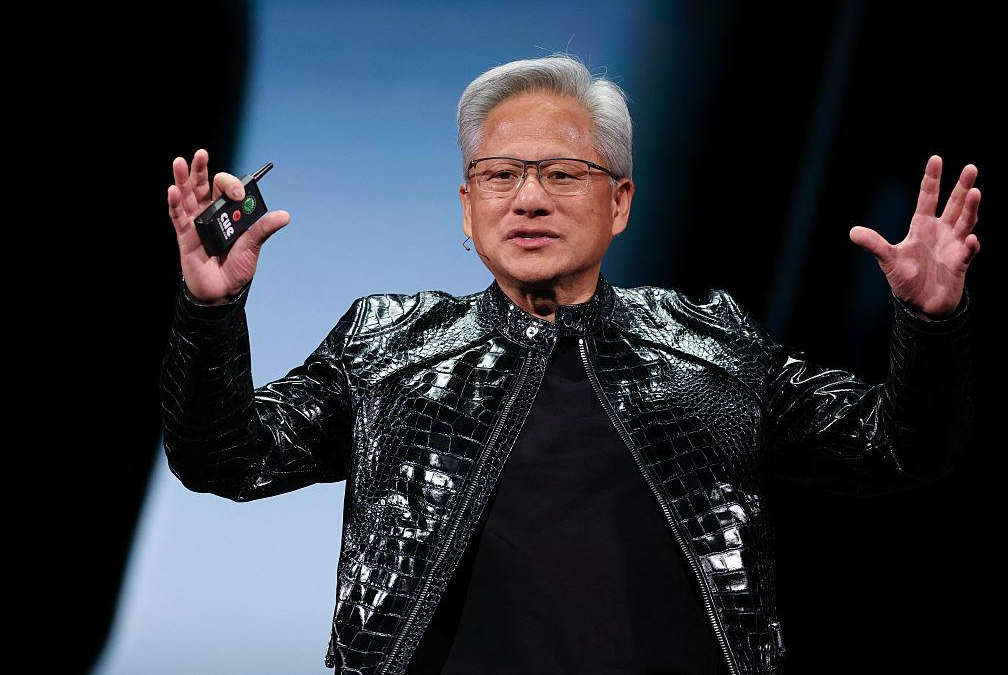
THE END OF THE JENSEN HUANG ERA
Huang’s influence on NVIDIA is difficult to overstate.
He founded the company in 1993 alongside Chris Malachowsky and Curtis Priem. NVIDIA introduced what it called the world’s first GPU in 1999, later developed its CUDA computing platform and eventually positioned its processors at the center of the modern artificial intelligence revolution.
What began as a company focused largely on computer graphics and gaming evolved into an AI infrastructure powerhouse whose technology now supports data centers, autonomous vehicles, robotics, scientific computing and generative AI.
NVIDIA reported a record $215.9 billion in fiscal 2026 revenue, illustrating the scale the company reached during Huang’s tenure.
Huang remains listed by NVIDIA as a company founder, but he no longer serves as president, CEO or a member of the board.
WHY THE TIMING MATTERS
The leadership change follows an unusually turbulent period for NVIDIA.
On November 8, NVIDIA’s board announced an independent investigation following reports that Huang had been targeted by a foreign intelligence effort. At the time, the board emphasized that it had no reason to believe NVIDIA secrets or U.S. national security had been compromised. Huang said he would cooperate fully with the review.
NVIDIA’s subsequent CEO-transition announcement did not specify a reason for Huang’s resignation.
Markets reacted sharply to the leadership change. NVIDIA shares finished November 12 approximately 4.3 percent lower after suffering considerably steeper losses earlier in the session.
WHAT HAPPENS NEXT?
Kress now inherits one of the most closely watched companies in the world at a pivotal moment.
NVIDIA is scheduled to report its fiscal third-quarter 2027 financial results on November 17, giving investors their first major opportunity to hear from the company following the leadership transition.
The larger question is whether NVIDIA can maintain the aggressive technological vision and execution that defined Huang’s 33-year tenure while transitioning to a new generation of leadership.
For more than three decades, Jensen Huang and NVIDIA were nearly inseparable.
Now, for the first time in the company’s history, NVIDIA must define what comes next without him as CEO.