
The French maison’s 2026 High Jewelry collection places exceptional gemstones at the center of the creative process, allowing color, form and movement to determine the design.
For Cartier, the starting point is not simply the sketch. It is the stone.
That philosophy defines Le Chœur des Pierres, Cartier’s 2026 High Jewelry collection, an expansive exploration of gemstones in which sapphires, emeralds, rubies, diamonds and other precious stones become the foundation for each creation.
Rather than forcing a gem into a predetermined design, Cartier approaches the process from the opposite direction. The individual color, proportions, brilliance and character of a stone guide the jewel that eventually surrounds it.
The result is a collection where craftsmanship is intentionally placed in service of the gemstone.
Exceptional Stones Take Center Stage
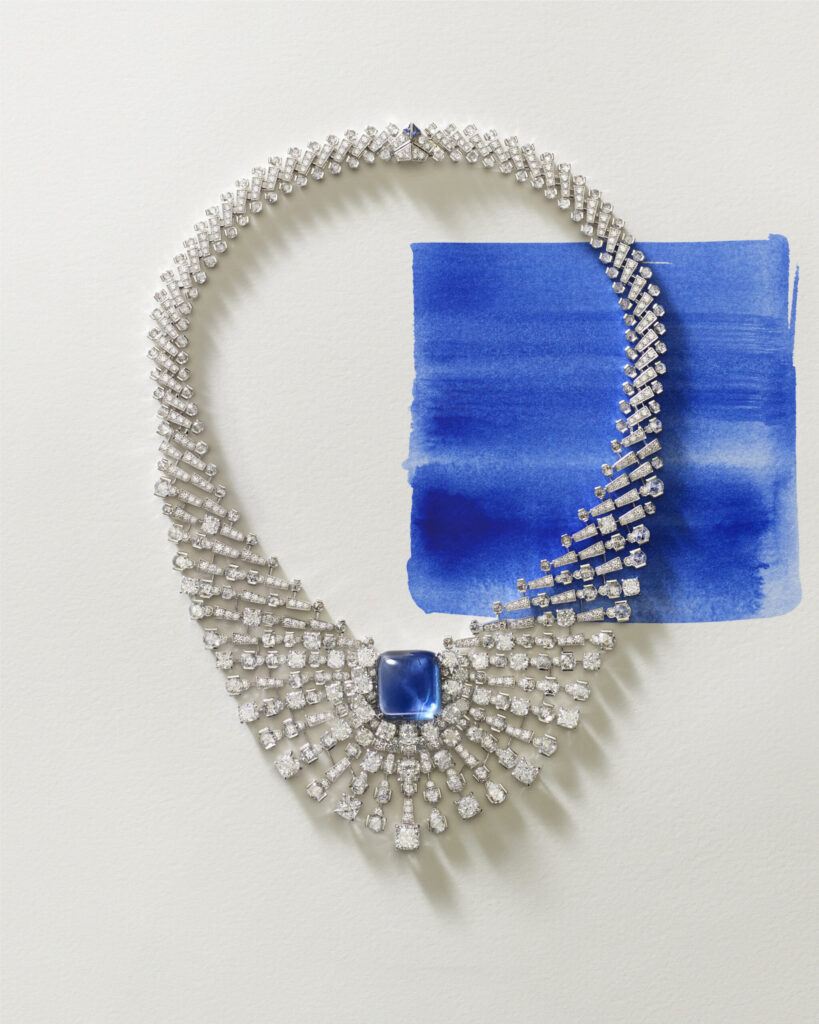
Among the collection’s standout creations is Stellara, a necklace centered around a 41.01-carat Ceylon sapphire. Cartier surrounds the stone with a precise arrangement of diamonds and geometric lines while maintaining the flexibility required for the necklace to move naturally when worn.
Panthère Tunya brings one of Cartier’s most recognizable symbols into the collection. A sculptural panther appears alongside a 48.12-carat Zambian cabochon emerald, cascading emerald beads and nine Fancy Yellow cushion-cut diamonds totaling 10.91 carats.
Elsewhere, Etnara places a 67-carat rubellite at the heart of a composition inspired by volcanic color, while Polydroma uses an Asscher-cut diamond weighing 5.18 carats within an architectural arrangement of diamonds and repeated geometric forms.



Cartier Revisits Its Own History
The collection also reconnects with one of the maison’s most distinctive design languages.
Tutti Chaya reinterprets Cartier’s historic Tutti Frutti aesthetic through rubies, emeralds, sapphires, diamonds and onyx. Two carved Colombian emeralds weighing a combined 56.97 carats anchor the design.
Its complexity extends far beyond what is immediately visible. According to Imagen Miami, the necklace required almost 2,000 hours of craftsmanship, including approximately 1,400 hours devoted to goldsmithing.
Even the reverse of the necklace was carefully considered, reinforcing the idea that high jewelry is as much an exercise in engineering and craftsmanship as it is visual spectacle.
Beyond the Necklace
Cartier carries the same philosophy into earrings.
Drosera incorporates 18 rubies totaling 28.44 carats into organic forms surrounded by diamonds, while Ojai creates a transition of pink and orange through 18 sapphires totaling 24.12 carats.
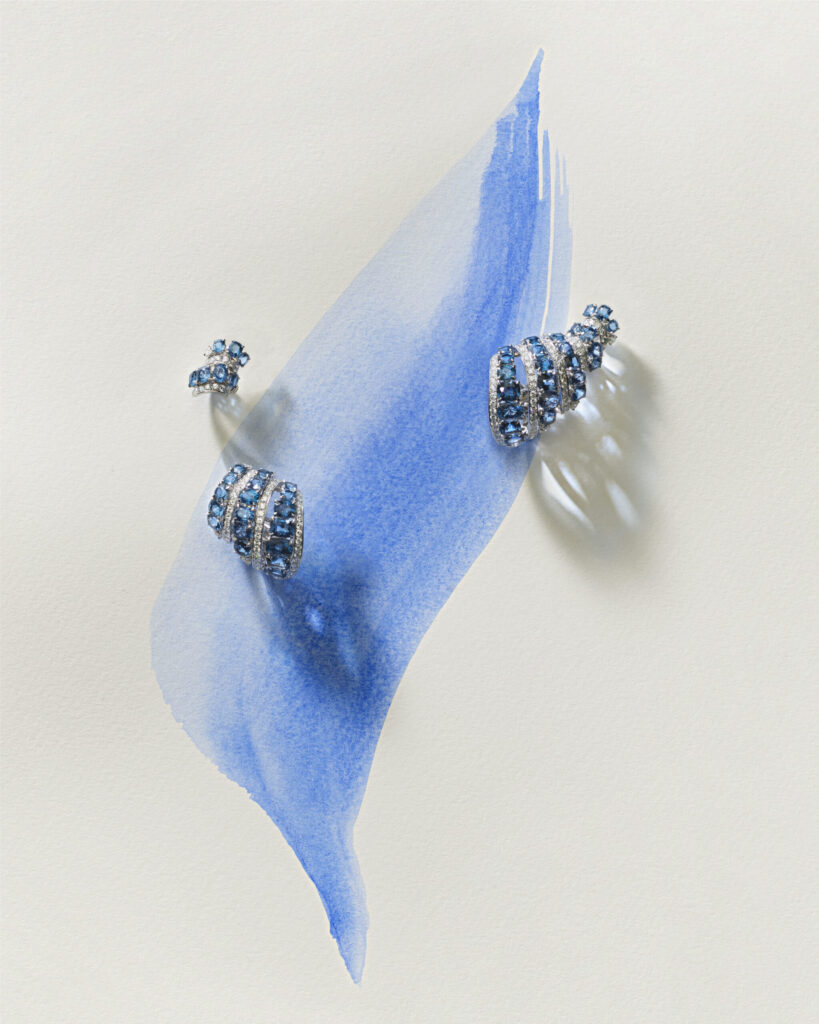
Patellia turns two pear-shaped brown diamonds totaling 11.32 carats upside down within a structure of white and brown diamonds. Undara moves in another direction entirely, using blue spinels and rounded forms inspired by the underwater world.
Across the collection, the common thread remains the same: the gemstone dictates the conversation.
For a house with more than a century of jewelry history, Le Chœur des Pierres is less about abandoning Cartier’s recognizable codes than allowing them to evolve around extraordinary natural materials.
The stones may be millions of years old. Cartier’s challenge is finding a new way to let them speak.