
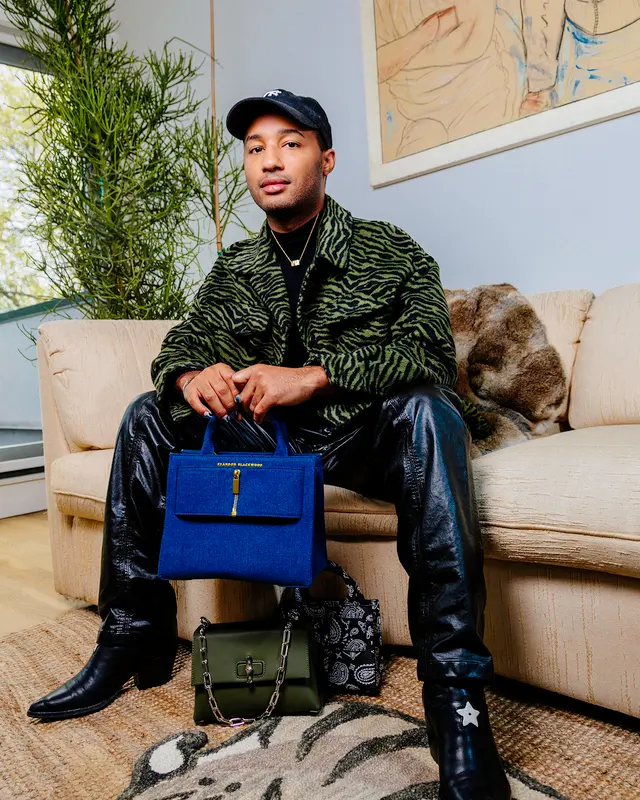
Brandon Blackwood has built one of contemporary fashion’s most recognizable accessories brands by making his identity part of the design language.
Born and raised in Brooklyn to Jamaican and Chinese parents, Blackwood is the founder, creative director and CEO of Brandon Blackwood New York. His Caribbean heritage is not a footnote in his story. It appears throughout the names, memories and cultural references that have shaped the brand from its beginning.
Before handbags became his career, fashion was something Blackwood was pursuing almost in secret. While attending Bard College, he initially studied neuroscience while simultaneously interning at publications including Elle and Nylon. After college, he worked at a consignment shop and continued developing his own ideas.
One of those ideas became the Portmore backpack — named for the Jamaican city. After people repeatedly asked Blackwood where they could buy the bag he had created for himself, he saw an opportunity. In 2015, Brandon Blackwood New York was born.
What followed was a gradual rise through fashion media and a growing community of customers. His first collection attracted attention from Essence, followed by other major publications, but the moment that dramatically changed the scale of the business came in 2020.
Against the backdrop of worldwide protests following the murder of George Floyd, Blackwood created the End Systemic Racism, or ESR, tote. The small structured bag carried those three words prominently across its front, turning an accessory into a direct statement about racial injustice.
The design went viral. Celebrities including Kim Kardashian were photographed carrying it, thousands of customers sought it out, and the bag pushed Brandon Blackwood into an entirely new level of visibility. Proceeds from releases of the ESR tote also supported organizations working on civil rights and communities of color. Today, an ESR tote is held in the collection of the Smithsonian National Museum of African American History and Culture.
But reducing Blackwood’s career to one viral bag misses the larger story.
Over the years, Brandon Blackwood New York has developed a distinct visual identity built around structured silhouettes, bold hardware, rich textures and bags that often draw directly from Black culture and Blackwood’s personal life. The company has expanded beyond handbags into categories including footwear, eyewear and outerwear, while his work has been worn by figures ranging from Beyoncé and Megan Thee Stallion to Cardi B and Serena Williams.
That growth has also brought institutional recognition. Blackwood became a member of the Council of Fashion Designers of America and was named to the TIME100 Next list in 2024. In September 2026, Harlem’s Fashion Row honored him as its Designer of the Year.
And in 2026, Blackwood made the Caribbean connection behind his work even more explicit.
His Heritage Collection transformed signature Nia and Luna handbags with Caribbean flag detailing, drawing inspiration from his Jamaican roots and childhood memories of attending New York’s West Indian Day Carnival with his family. The accompanying campaign turned toward family history, with Blackwood inviting his grandmother Christeen and uncle Noel to speak about their memories of life in Jamaica.
It was a particularly fitting expression of what Brandon Blackwood has been building all along: luxury that does not require its creator to distance himself from where he comes from.
Brooklyn is there. Jamaica is there. His Chinese heritage is there. Black culture is there. And increasingly, a wider Caribbean diaspora can see itself reflected in the world surrounding the brand.
That may be one of the most important elements of Blackwood’s success. The bags are fashion objects, but the brand around them is also about recognition — taking histories, communities and cultural references that have not always been treated as luxury and confidently placing them within that conversation.
More than a decade after launching his label, Brandon Blackwood is no longer simply an emerging designer with a breakout handbag.
He is helping define what modern American — and Caribbean diasporic — luxury can look like.