
Born in Patagonia and now working from London, Nelson Hernández occupies two very different worlds. That distance — between geographic isolation and one of the centers of the international art market — has become fundamental to a practice examining what happens to identity, history and local culture as images move across borders.
Hernández works primarily in oil and acrylic, but the construction of his paintings often begins digitally. Museum sculptures, historical objects, toys and fragments of popular culture can be captured through photogrammetry and 3D modeling, reorganized into new compositions and ultimately returned to the physical language of painting.
The result is deliberately unstable. European art history can occupy the same visual space as animation. A museum object can carry no more—or less—importance than an image pulled from mass culture. Hernández removes the hierarchy that traditionally separates what is considered culturally significant from what is considered disposable.
That approach reached a striking point with Errantes, his 2026 solo presentation with Isabel Croxatto Galería at the inaugural PARAÍSO Art Fair in London.
ERRANTES: THE BATTLE OF IMAGES
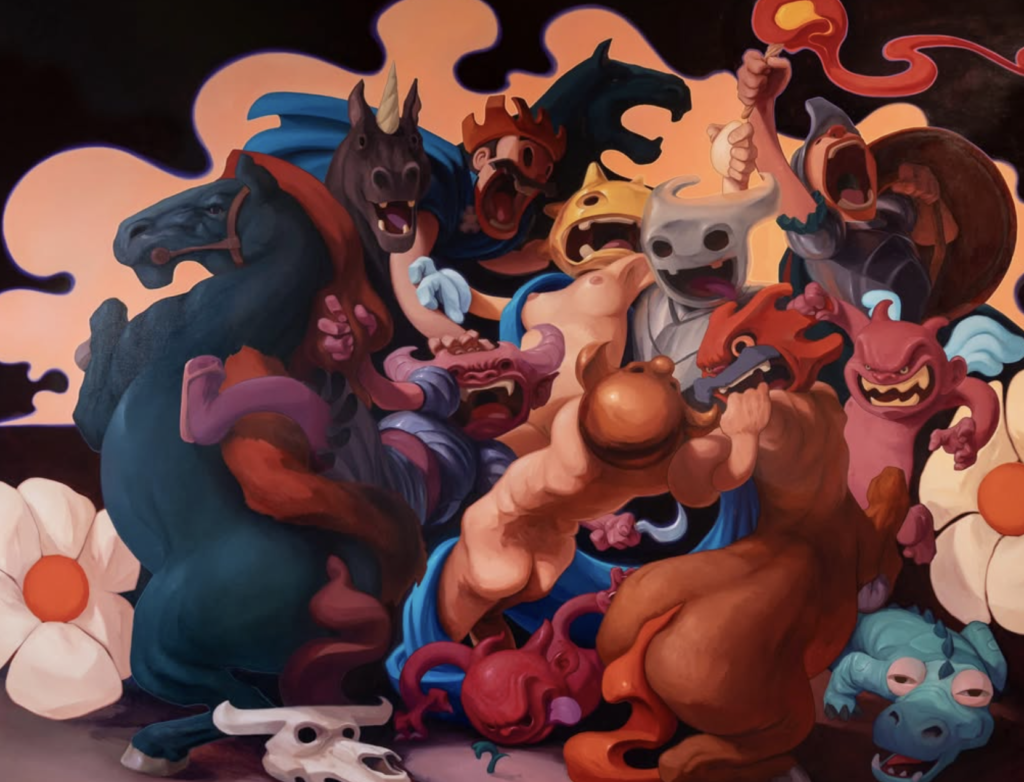
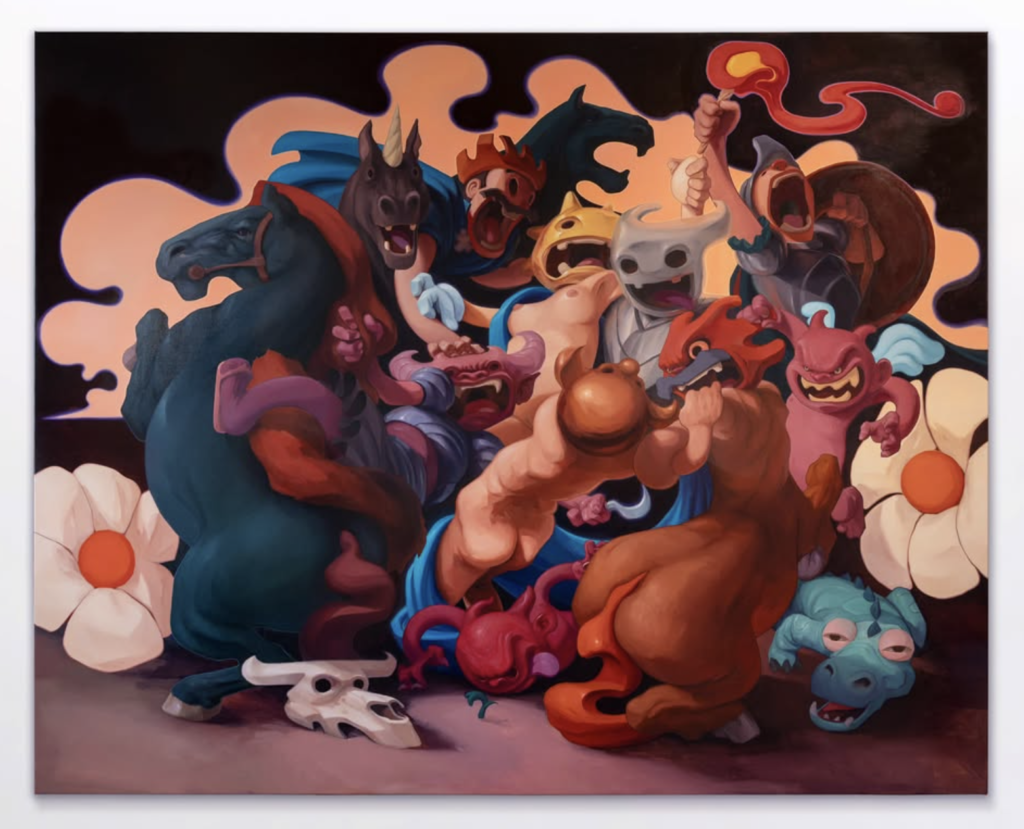
At the center of the presentation was Errantes, a monumental oil-on-linen painting measuring 200 × 250 centimeters.
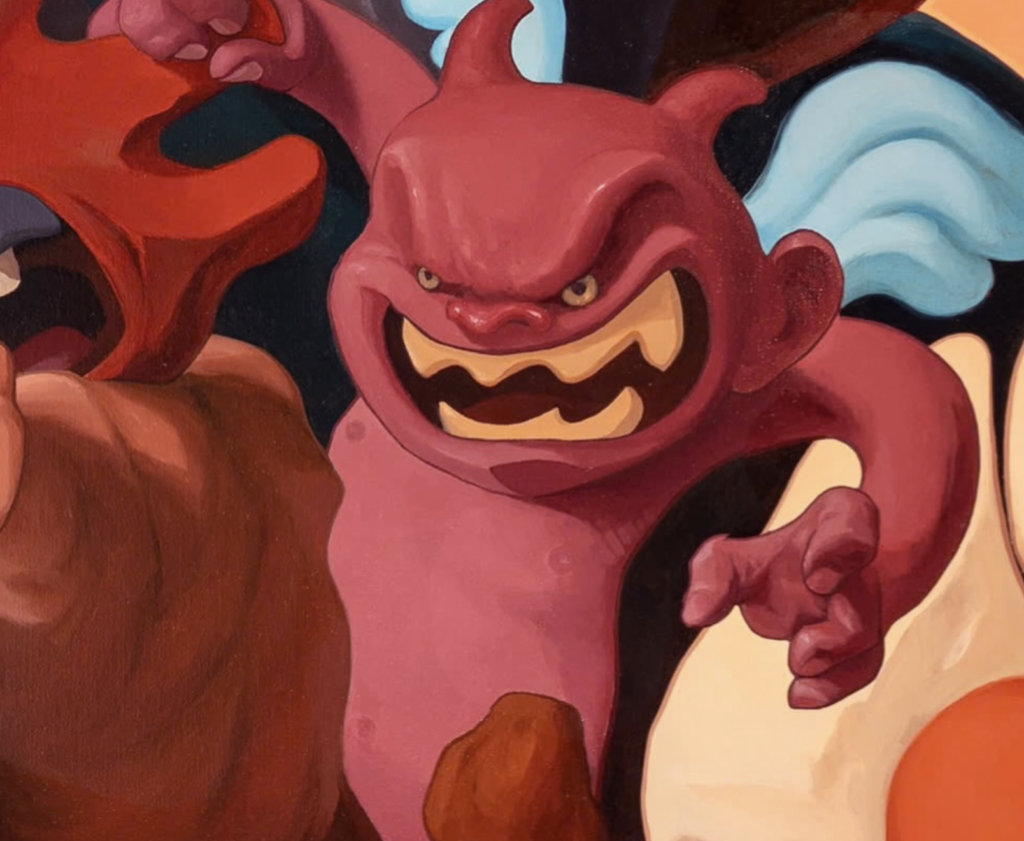
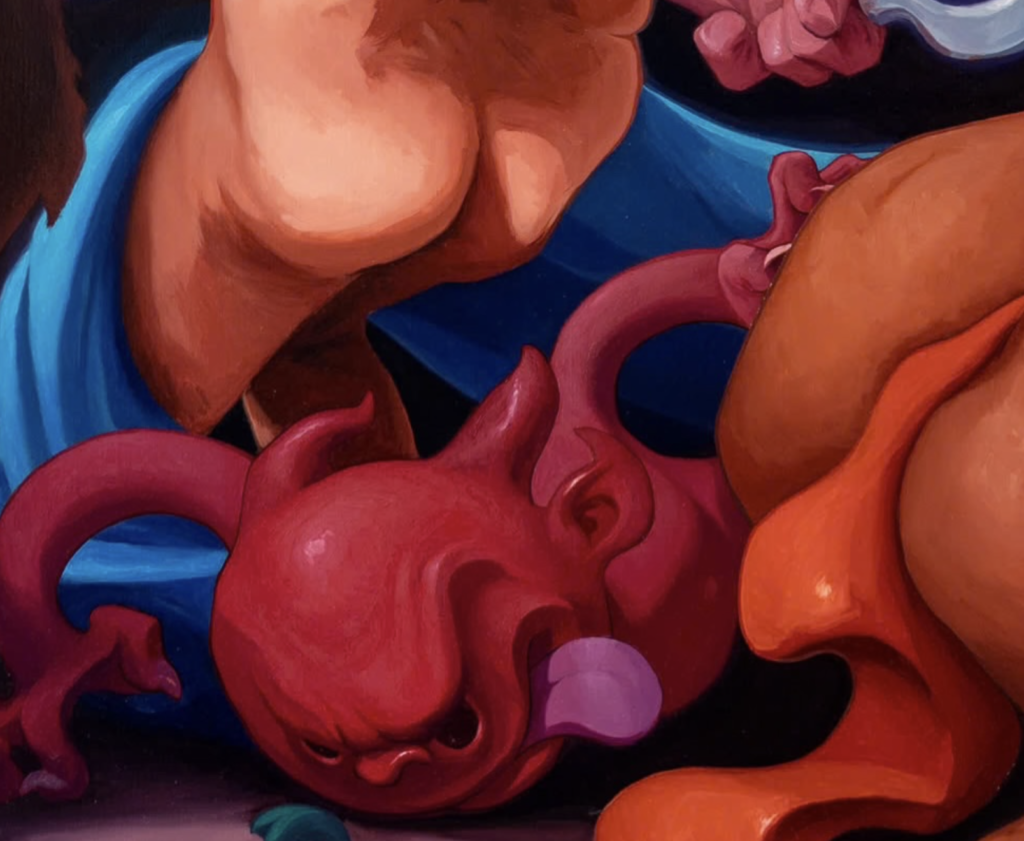
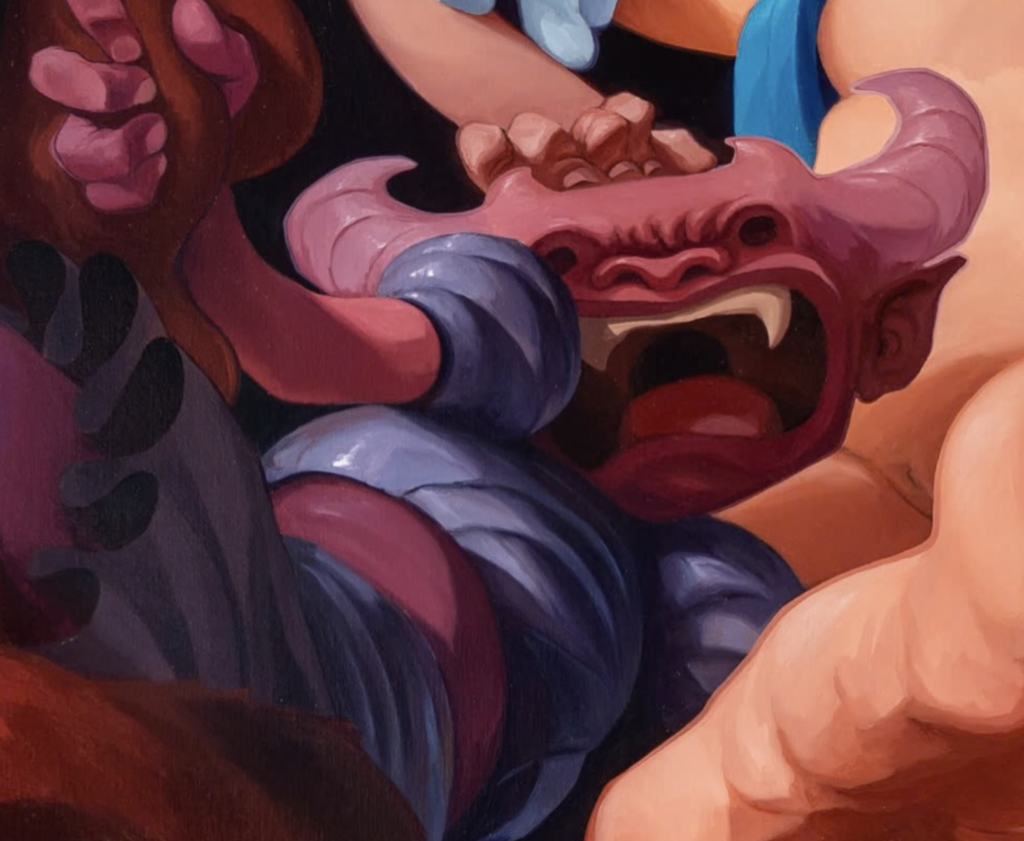
Its composition borrows the visual authority of the Baroque battle painting: dramatic bodies, darkness and tenebrist light traditionally associated with scenes of conquest and power. But Hernández replaces the expected historical warriors with figures originating in cartoons.
The collision is intentional.
Rather than treating one visual language as prestigious and the other as trivial, Hernández gives both equal weight. Cartoon bodies inherit the theatrical gravity of historical painting while the authority normally granted to the European canon begins to destabilize.
The title reaches even further back.
The Romans used the idea of stellae errantes—wandering stars—to describe seven celestial bodies that appeared to behave differently from the fixed stars around them. They advanced, paused and reversed course according to their own trajectories.
For Hernández, wandering becomes both movement and disruption. Something that refuses the established route can initially appear to be an error in the system.
That idea becomes a metaphor for migration.
Images migrate. Languages migrate. Religious and mythological symbols migrate. People migrate. Each changes as it moves through new places, cultures and systems of meaning.
In Errantes, being “out of place” is not necessarily a failure. It becomes the condition from which something new can emerge.
FROM PATAGONIA TO LONDON
Hernández was born in Punta Arenas in Chilean Patagonia and studied Visual Arts at the Pontificia Universidad Católica de Chile before completing an MA in Painting at London’s Royal College of Art.
His geographic journey matters because his work repeatedly examines the tension between the local and the global.
The artist has described globalization’s erosion of cultural specificity as a central concern within his practice. Instead of presenting identity as something fixed, Hernández looks at what happens when histories, symbols and visual references continually encounter one another.
His growing international profile has included work shown at London’s National Portrait Gallery, where he was selected for the 2025 Herbert Smith Freehills Portrait Award, as well as exhibitions at the Saatchi Gallery. His 2026 solo exhibition Fever Dreams was presented by Isabel Croxatto Galería in Santiago.
A LATIN AMERICAN VOICE INSIDE LONDON’S ART WEEK
Errantes was presented at PARAÍSO, the new London fair dedicated to Latin American art and its diaspora, held at Ambika P3 from October 15–18, 2026 alongside Frieze Week.
The inaugural edition brought together 22 international galleries and projects alongside 12 individual artist presentations, positioning contemporary Latin American practices directly within one of the world’s most influential art weeks.
For Hernández, that context feels particularly appropriate.
His paintings resist the idea that culture develops cleanly within geographic or historical boundaries. Everything travels. Everything becomes contaminated by something else. And traditions that appear permanent are often themselves the products of centuries of exchange.
Errantes ultimately asks viewers to reconsider the figure that does not follow the expected orbit.
The wanderer may initially appear misplaced.
Hernández suggests that the displacement itself may be where the most interesting transformation begins.